


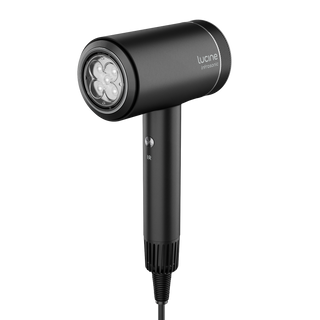


A sleek, straight blow-dry doesn't have to end with a flat iron picking up where the dryer left off. Once you know how to blow dry hair straight using just a brush and the concentrator nozzle, the flat iron becomes an optional touch-up at most, not the tool doing the real work. The method rests on two things happening together while hair is still damp: a brush pulling each section taut, and the nozzle directed straight down the hair shaft as it dries. Worked section by section from root to end, this brush-and-nozzle method builds a smooth, flat finish that holds its own well past the mirror.
How to Blow Dry Hair Straight, Step by Step
The straight finish comes from a rhythm you repeat section by section: part off a thin, workable piece of hair, pull it taut with a brush from root to end, and follow that brush with the nozzle angled down the hair shaft the whole way through. Once a section is dry to the touch, a short pass of cool air locks it in place before you move to the next one. Skip any one part of that rhythm — rush the tension, aim the nozzle off to the side, or skip the cool-air set — and the section relaxes out of its shape before you've finished the rest of the head.
Sectioning Hair for a Straight Blow-Dry
Start on hair that's towel-dried rather than dripping, and clip it into layers: a horizontal part separating the bottom third from the rest, then working upward in similar bands as each layer finishes. Within each layer, take horizontal sections no wider than about two finger-widths — a section that's too wide won't dry evenly across its full width, and the ends closer to your fingers usually end up straighter than the ones toward the middle. Keep the rest of the hair clipped up and out of the way so it doesn't fall across a section you've already finished.
Brush Tension: Pulling Each Section Straight
Place a flat or paddle brush underneath the section, close to the root, and draw it down toward the ends in one continuous, even motion, keeping the hair taut against the brush the entire way. That steady tension is what actually flattens the section as it dries — a brush that pauses partway through or a grip that loosens near the ends lets that part of the hair dry with more natural movement in it, which shows up as a less uniform finish once the whole head is done. Slow, complete passes from root to end work better here than several short, rushed ones.
Angling the Nozzle Along the Hair Shaft
Fit Lucine's concentrator nozzle and hold it just behind the brush, angled so the airflow runs down the length of the section in the same direction the brush is pulling — not straight down onto the section from above. Keep the nozzle a few centimetres off the hair rather than pressed against it, and let it travel with the brush at the same pace instead of racing ahead or trailing behind. This is what keeps the drying airflow working with the tension the brush is creating, instead of drying one part of the section before the brush has even reached it.
Locking the Style With Cool Air
Once a section feels fully dry under your fingers, hold the brush in place for a moment and switch Lucine to the cool-air setting before releasing it. Warm, freshly dried hair is still flexible enough to soften back out of a straight line if you let go too soon; a short pass of cool air while the brush still holds the tension is what sets the section so it keeps its shape once you move on. Work through each layer this way, from the underneath sections out to the top, before doing a final pass over the whole head.
Mistakes That Undo a Straight Blow-Dry
Taking sections that are too wide is the most common one — the brush and nozzle simply can't cover the full width evenly in a single pass, so the middle of the section ends up less straight than the edges. Aiming the nozzle across the section instead of down its length is another: it dries the surface quickly but leaves movement underneath that shows up once the hair cools. The third is releasing brush tension the moment a section looks dry rather than holding it through the cool-air step, which gives the hair a chance to soften back out of the shape you just built before it's had time to fully set.
For the sectioning and brush fundamentals behind any polished blow-dry, see The Round-Brush Blowout: Build Shape With Lucine, One Section at a Time. To check Lucine's concentrator nozzle for this method, visit the Lucine InfraSonic Hairdryer page.
Share:
Flat Roots? Build Lift With Your Dryer and Brush
The Flipped-Ends Blowout: Bring Back the Outward Flick